
PTFE Bottles - PTFE Labware
PTFE Chemical Resistance: A Guide for Laboratory Buyers
PTFE (polytetrafluoroethylene) offers broad chemical resistance, making it useful for many demanding laboratory reagents. That resistance is not a universal guarantee of compatibility. Assess the chemical and the complete bottle assembly under the conditions of your procedure before choosing a vessel.
What Affects Chemical Compatibility?
- Chemical identity and concentration: review each reagent, mixture and cleaning agent. Resistance to one concentration does not establish suitability for all concentrations or mixtures.
- Temperature and contact time: confirm conditions for short handling steps and long-term storage separately.
- Closures and seals: check every wetted component, including the cap, liner or dispensing accessory.
- Mechanical conditions: pressure, vacuum and repeated handling require separate product or assembly ratings.
Resistance, Permeation and Purity Are Different
A material may resist visible chemical attack while substances still permeate it. The original supplier guidance below notes that halogens can penetrate PTFE without apparent reaction. It also lists exceptions involving sodium in liquid ammonia and some fluorine compounds at elevated temperature and pressure. Consult current manufacturer compatibility information for the exact process.
For high-purity work, confirm the resin and finished-product documentation required by your laboratory. A general FDA or USP Class VI material statement is not a substitute for evidence covering your specific item and intended use.
Selecting a PTFE Bottle
Compare PTFE bottles by capacity, opening and closure. Allow suitable headspace, check the seal and confirm that any replacement cap matches the bottle thread. The current TEFLEX range includes 50–1000 mL heavy-wall screw-cap bottles. Do not infer transport approval or pressure capability from chemical resistance or a leak-resistant closure.
For a broader purchasing checklist, read our guide to choosing PTFE beakers, bottles and labware. Pair storage vessels with PTFE beakers for preparation or PTFE funnels for suitable transfer workflows.
Existing PTFE Bottle Features and Supplier Material Notes
The original material information below is retained for context. Check the individual product's current operating limits and supporting documentation; material temperature data must not be treated as the safe working limit of every bottle or closure.
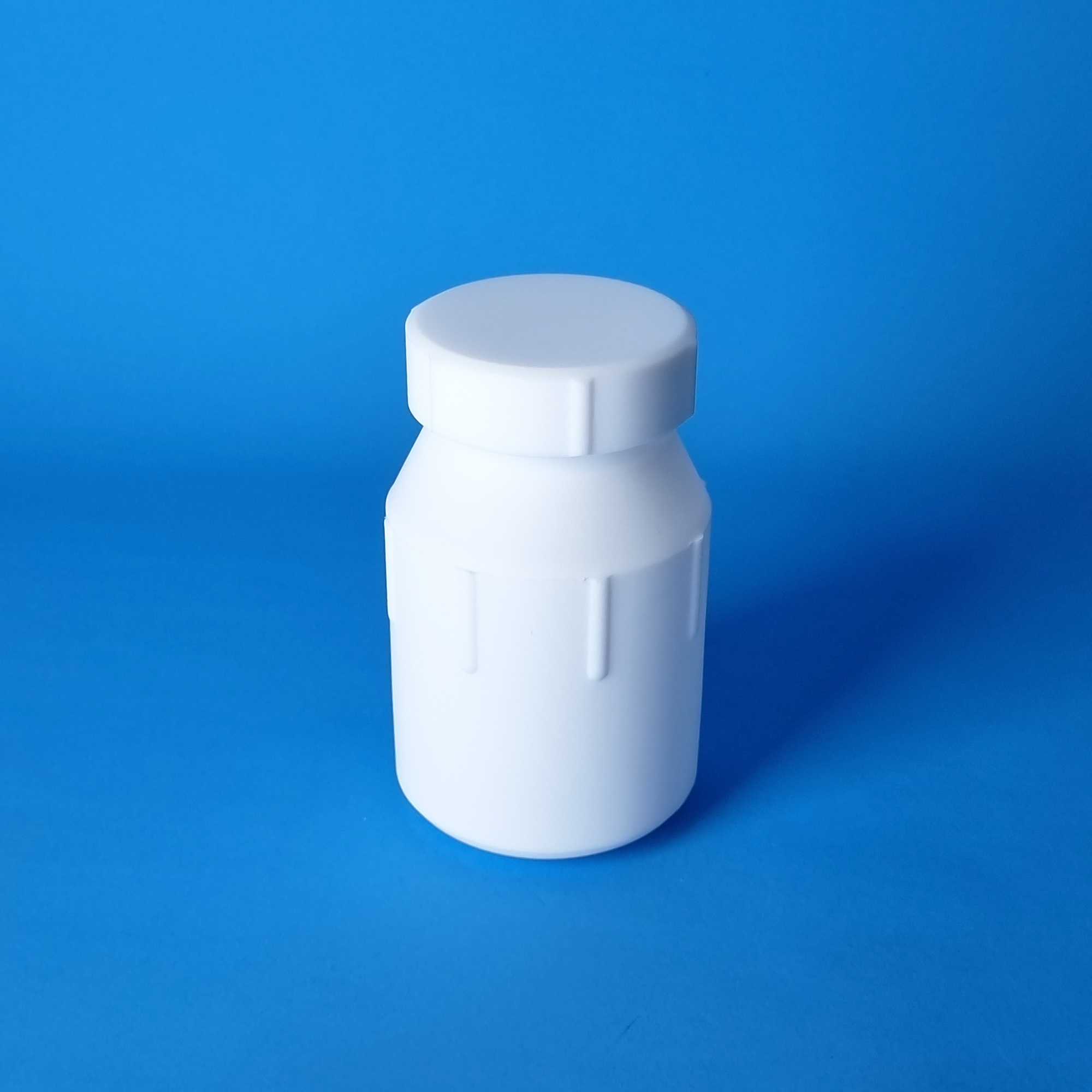
PTFE Bottles - PTFE Labware
- Isostatically molded in pure PTFE
- Machined base for good heat transfer
- Broad chemical resistance and low reactivity; compatibility exceptions apply
- Heavy wall construction with super smooth internal finish
- Bottles have a special screw cap housing for leak-free performance
- Suitable for low temperature applications
TEFLEX are the worlds leading specialist for the design and manufacture of PTFE Laboratory Products, including PTFE beakers, PTFE Bottles, PTFE coated magnetic stirring bars and PTFE Stirring shafts.
PTFE used in the manufacture of TEFLEX Laboratory bottles is pure, virgin material. PTFE is the material of choice for:
Chemical Resistance
The chemical resistance of PTFE is almost total over its working temperature range. Reaction is limited to some compounds with free electrons such as sodium in liquid ammonia and some fluorine compounds at high temperature and pressure. Halogens will penetrate PTFE but without apparent reaction.
Thermal Stability
The thermal stability of PTFE is outstanding. The existing material guidance cites use to approximately 280°C and resistance to embrittlement at liquid-helium temperatures. These are material properties, not operating limits for every finished product. The approximately 400°C degradation figure is not a safe working temperature. Follow the stated limit for the specific bottle and closure.
Insolubility & Purity
The PTFE we use conforms to USP Class VI and FDA requirements and is intrinsically pure and contains no additives. PTFE is insoluble in all known solvents except under extremes of pressure and temperature and will not contaminate media by dissolution.
Sterilisation
PTFE can be sterilised by all usual means except gamma radiation.
Browse the current PTFE laboratory bottles and complete PTFE fluoroware range from LabDirect Australia.
Recent Posts
-

Introducing JRI MySirius: Connected Monitoring for Your Laboratory
Keeping track of laboratory storage conditions is easier when measurements, trends and alerts are av …9th Oct 2026 -
How to Choose a Laboratory Overhead Stirrer: Torque, Viscosity, RPM and Shaft Selection
Choosing a laboratory overhead stirrer means matching the drive, impeller and vessel to the sample. …2nd Oct 2026 -
5 Advantages of Peristaltic Pumps for Accurate Liquid Transfer in Laboratories
In modern scientific laboratories, precision liquid handling is critical. Whether transfer …12th May 2026