
PTFE Beakers & Bottles - PTFE Labware
How to Choose PTFE Labware for Your Laboratory
PTFE labware can support demanding chemical-handling workflows, but choosing an item requires more than selecting a chemically resistant material. Match the vessel or accessory to your reagent, working volume, temperature and handling method.
Match the Labware to the Task
- Choose PTFE beakers for preparing, mixing and pouring compatible solutions. Allow headspace and use calibrated equipment for precise volume measurement.
- Choose PTFE bottles for compatible reagent storage. Check the bottle, cap, seal, fill volume and labelling requirements together.
- Compare PTFE funnels for transfer or suitable filtration assemblies. Check dimensions, filter medium and the receiving vessel connection.
- Select PTFE magnetic stirring bars to suit the vessel base, liquid viscosity and magnetic stirrer. Inspect the coating before reuse.
A Practical PTFE Purchasing Checklist
- Identify the chemical and concentration, including cleaning agents.
- Confirm operating temperature and exposure time against the specific product documentation.
- Compare nominal capacity, dimensions, opening and closure compatibility.
- Check any pressure or vacuum requirement separately; material resistance is not an assembly rating.
- Request purity or compliance documentation where required by your method.
Read our PTFE chemical resistance and bottle selection guide for a closer look at compatibility. Browse the current PTFE fluoroware range to compare available TEFLEX products.
Original COWIE PTFE Labware Information
The original article below describes COWIE labware. It is retained as historical product information and should not be taken as certification or a specification for every item currently sold. Check the manufacturer and individual listing when ordering.
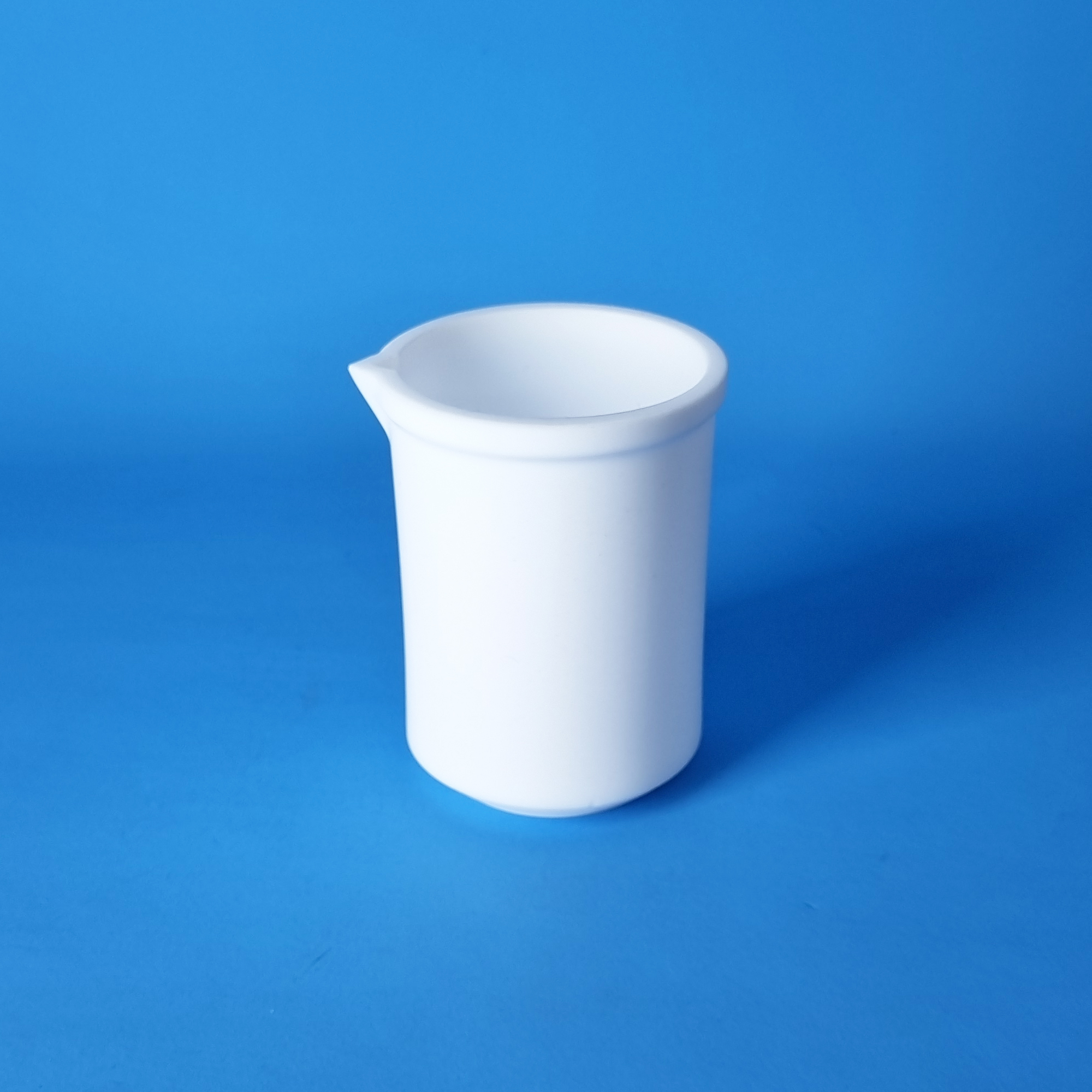
PTFE Beakers & Bottles - PTFE Labware
- Isostatically molded in pure, FDA approved, PTFE
- Machined base for good heat transfer
- Molded-in pouring spout on beakers
- Broad chemical resistance and low reactivity; compatibility exceptions apply
- Heavy wall construction with super smooth internal finish
- Bottles have a special screw cap housing for leak-free performance
- Suitable for low temperature applications
Cowie are the worlds leading specialist for the design and manufacture of PTFE Laboratory Products, including PTFE beakers, PTFE Bottles, PTFE coated magnetic stirring bars and PTFE Stirring shafts.
PTFE used in the manufacture of COWIE® PTFE Laboratory Products is pure, virgin material which conforms to FDA and USP Class VI requirements. PTFE is the material of choice for:
Chemical Resistance
The chemical resistance of PTFE is almost total over its working temperature range. Reaction is limited to some compounds with free electrons such as sodium in liquid ammonia and some fluorine compounds at high temperature and pressure. Halogens will penetrate PTFE but without apparent reaction.
Thermal Stability
The thermal stability of PTFE is outstanding. The historical material guidance cites use to approximately 280°C and resistance to embrittlement at liquid-helium temperatures. These material properties do not establish a working limit for each finished product. The approximately 400°C degradation figure is not a safe operating temperature. Follow the manufacturer’s stated limit for the selected item.
Insolubility & Purity
The PTFE we use conforms to USP Class VI and FDA requirements and is intrinsically pure and contains no additives. PTFE is insoluble in all known solvents except under extremes of pressure and temperature and will not contaminate media by dissolution.
Sterilisation
PTFE can be sterilised by all usual means except gamma radiation.
For current product options, browse PTFE beakers, PTFE bottles and the complete PTFE labware range.
Recent Posts
-

Introducing JRI MySirius: Connected Monitoring for Your Laboratory
Keeping track of laboratory storage conditions is easier when measurements, trends and alerts are av …9th Oct 2026 -
How to Choose a Laboratory Overhead Stirrer: Torque, Viscosity, RPM and Shaft Selection
Choosing a laboratory overhead stirrer means matching the drive, impeller and vessel to the sample. …2nd Oct 2026 -
5 Advantages of Peristaltic Pumps for Accurate Liquid Transfer in Laboratories
In modern scientific laboratories, precision liquid handling is critical. Whether transfer …12th May 2026